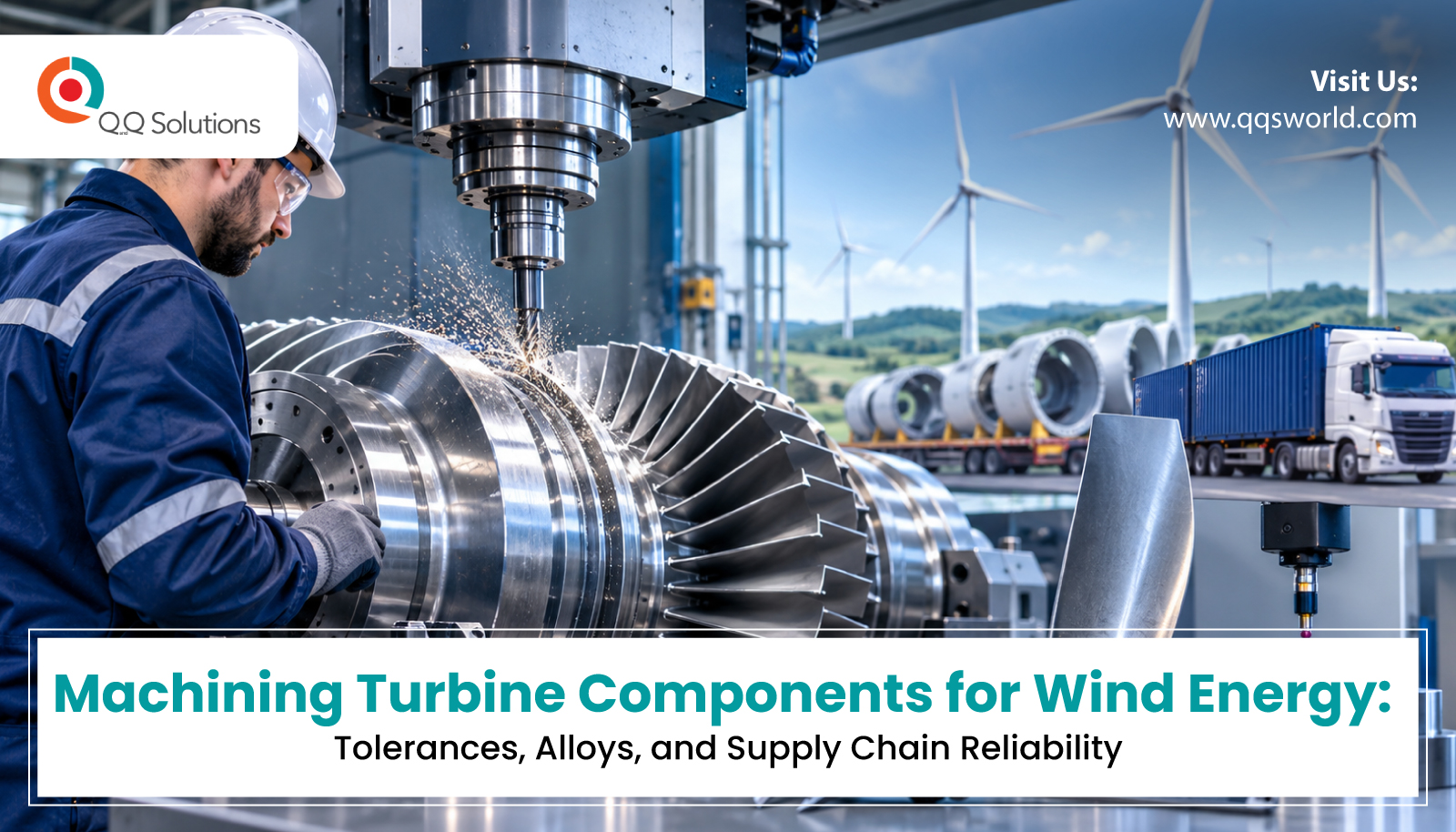
Wind energy equipment operates in an environment where reliability is not optional.
Wind turbines experience continuous cyclic loading, vibration, changing temperatures, weather exposure and demanding operating conditions. Components must therefore be manufactured with a high degree of consistency, dimensional accuracy and material control.
For manufacturers and procurement teams, turbine component machining is not simply about achieving a dimension on a drawing. It is about producing components that maintain their dimensional and mechanical integrity through assembly and long-term operation.
This is where precision CNC machining, appropriate alloy selection, process control and supply-chain reliability become equally important.
A modern wind turbine consists of numerous components working together as a mechanical system.
Depending on the turbine architecture, these can include:
Many of these components have critical interfaces where dimensional accuracy affects assembly, alignment, load transfer or operational performance.
A small deviation in one component may create assembly difficulties or introduce additional stresses elsewhere in the system.
CNC machining provides manufacturers with repeatable control over complex component geometries.
Depending on component size and design, manufacturing may involve:
QQS has CNC machining capabilities covering different component geometries and materials, supported by high-precision machining centres and vertical turning equipment.
Material selection depends heavily on the component’s function.
Different parts may require:
Steels remain important engineering materials for many heavy-duty turbine components because of their strength and availability.
Alloy additions can improve characteristics such as hardenability, strength, toughness and wear resistance.
Stainless steel can be valuable where corrosion resistance is a key consideration.
For components exposed to demanding environmental conditions, the correct grade must be selected based on the actual application rather than using “stainless steel” as a generic specification.
Aluminium alloys may be appropriate where weight reduction is important and the component’s mechanical requirements permit their use.
QQS has experience across ferrous and non-ferrous materials and supports components made from aluminium and other special alloys.
One of the biggest misconceptions about precision manufacturing is that tighter tolerances always mean better components.
That is not necessarily true.
The correct tolerance is the tolerance required to ensure the component performs its intended function.
A tolerance strategy should distinguish between:
Critical dimensions
These directly affect assembly, alignment, load transfer or sealing.
Functional dimensions
These influence component performance but may permit somewhat broader limits.
Non-critical dimensions
These generally require only the accuracy necessary for fit, appearance or manufacturability.
This approach prevents unnecessary machining costs while protecting critical performance characteristics.
Dimensional accuracy is only one aspect of precision machining.
For turbine components, geometric requirements may include:
For example, a shaft may have the correct diameter but still create problems if the relevant surfaces are not sufficiently concentric.
This is why CNC precision parts should be evaluated using the complete drawing specification rather than individual dimensions alone.
Wind energy equipment frequently includes components that are physically large or heavy.
Manufacturing these parts requires more than a high-accuracy cutting tool.
It requires:
QQS’s infrastructure includes horizontal machining centres, vertical turning lathes and machining clusters designed to handle both large-scale production and smaller custom orders.
Not every turbine component needs to be machined from solid material.
Where the component has substantial mass or complex geometry, casting can provide a more efficient starting point.
The manufacturing route can therefore be:
Casting → Heat Treatment → Rough Machining → Finish Machining → Inspection → Surface Treatment
This method can minimize material removal and shorten machining time.
It also allows the component geometry to be optimised around casting rather than forcing a machining-only manufacturing strategy.
QQS provides both casting and CNC machining capabilities, allowing customers to evaluate combined manufacturing routes for precision engineered components. For a leading brand from Europe, QQS has been a supplier of various types of ferrous and Non ferrous parts to multiple plants. As a investor funded company where part of $60M has been already received it is in a position to establish dedicated facilities including metal fabrication etc.
For cast components, machining allowance is critical.
Too little allowance can make it impossible to achieve the final dimension after casting variation.
Too much allowance increases:
The best machining allowance is therefore developed around the capability of the casting process and the required final tolerances.
Surface finish requirements should also be tied to function.
Certain bearing or sealing interfaces may require controlled surface characteristics.
Other external surfaces may not require the same level of finishing.
Over-specifying surface roughness across an entire component can unnecessarily increase production costs.
Inspection requirements should be defined at the RFQ stage.
Potential inspection activities include:
The exact inspection plan depends on the component and customer specification.
For critical components, suppliers may also need to provide material certificates, inspection reports and traceability documentation.
Some defects cannot be identified through conventional dimensional inspection.
Depending on material and application, non-destructive testing may be used to identify potential discontinuities.
Possible methods include:
NDT should be incorporated into a defined quality plan rather than added at the end of production.
A technically capable machining supplier is not automatically a reliable supply-chain partner.
Wind energy manufacturers often need consistency over multiple production batches.
A supplier should therefore be evaluated on:
This is particularly important for small batch manufacturers, where production volumes may fluctuate but quality expectations remain high.
Suppose a wind component is manufactured through five separate suppliers:
A delay at any stage can affect final delivery.
If engineering changes occur, coordination becomes even more difficult.
A manufacturer capable of coordinating multiple operations can reduce these handoffs.
QQS positions its manufacturing model around end-to-end responsibility and supply-chain partnerships, with capabilities spanning CNC machining, casting, forging, aluminium extrusion and fabrication.
A strong RFQ should include:
If the component is replacing an existing part, photographs and samples can also be useful during the initial technical evaluation.
Before selecting a supplier for turbine component machining, ask:
If casting, machining and finishing are required, determine whether the supplier can coordinate the entire route.
Machine envelope and workholding capability are particularly important for larger turbine components.
Ask about inspection equipment, process controls and measurement methods.
For critical components, understand which NDT methods are available.
Material certificates and batch traceability may be important for critical applications.
Wind projects and replacement-part programmes do not always involve high-volume production.
A supplier’s ability to handle low-volume, high-mix requirements can therefore be valuable.
The lowest component price does not necessarily produce the lowest total cost.
Procurement teams should consider:
Part price + tooling + freight + inspection + rejection risk + inventory + lead-time risk + supplier management
A slightly higher unit price from a reliable supplier may be commercially better if it significantly reduces quality problems or delivery uncertainty.
India offers a broad manufacturing ecosystem covering machining, casting, forging, fabrication and engineering services.
For international buyers, the opportunity is not simply lower manufacturing cost.
A capable Indian supplier can become part of a broader global supply chain when it combines:
QQS operates from Coimbatore and states that it supports global deliveries across markets including the United States, Europe, Germany, Spain, Poland, Dubai and Singapore. As an investor funded company where part of $60M has been already received, it is in a position to augment its current facilities with large capex to meet OEM expectations.
Wind turbine components demand more than dimensional accuracy.
The manufacturing process must account for material behaviour, fatigue-related demands, geometric tolerances, surface requirements, inspection and supply-chain consistency.
For some components, CNC machining from a bar or billet may be appropriate. For others, a casting followed by precision machining may offer a better manufacturing route.
The strongest results come from evaluating the component as an engineered system rather than treating machining as an isolated operation.
For companies sourcing turbine component machining, CNC precision parts, precision machined parts or precision engineered components in India, the ideal manufacturing partner is one that can combine engineering knowledge, production capability, quality control and dependable supply-chain execution.
