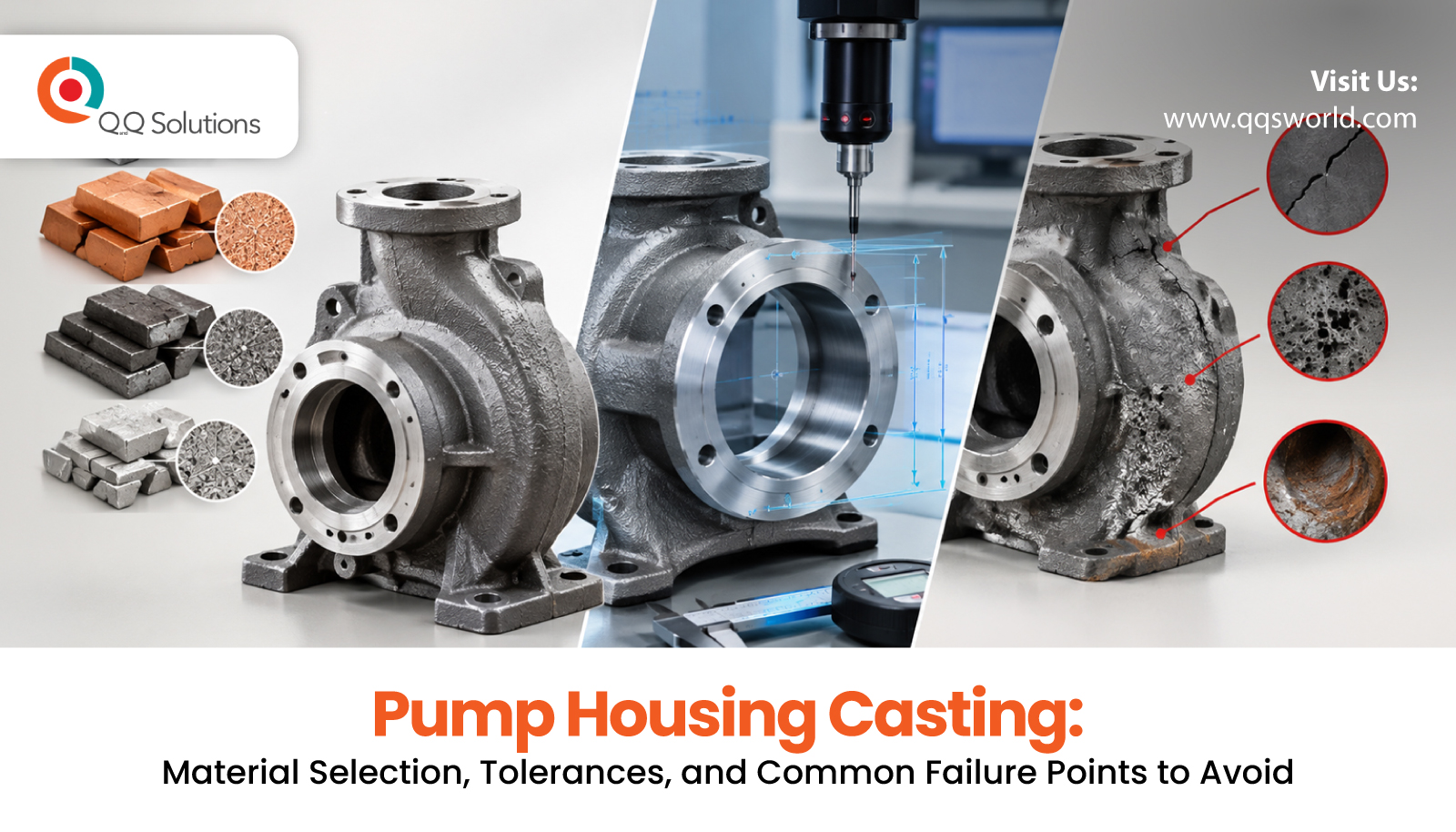
A pump housing may appear to be a relatively straightforward metal component, but its manufacturing requirements can be demanding.
The housing must contain fluid, withstand pressure and vibration, maintain dimensional stability, accommodate shafts, seals and bearings, and provide accurate interfaces for assembly.
For many industrial pumps, casting is an effective way to manufacture the housing because it allows complex external and internal geometries to be produced without machining the entire component from solid material.
However, a successful pump housing casting depends on much more than selecting a foundry and pouring metal into a mould.
Material selection, casting design, machining allowances, tolerances, heat treatment, inspection and finishing all influence the final performance of the component.
The pump housing, sometimes referred to as a casing, provides the structural enclosure around the pump’s internal components.
Depending on pump type and application, the housing may incorporate:
The geometry is often optimised for fluid flow while also maintaining sufficient structural strength.
This combination makes pump housings a natural application for casting and subsequent machining.
Manufacturing a pump housing entirely through CNC machining can involve substantial material removal, particularly when the component has complex internal cavities.
Casting provides a near-net-shape starting point.
The casting creates the overall geometry while machining establishes the dimensions that require greater precision.
This makes casting and machining an effective combination for manufacturing industrial pump components.
Material selection should begin with the operating environment rather than simply the purchase price of the raw material.
Key questions include:
Cast iron is suitable for a wide range of traditional industrial pumping applications.
Its advantages may include:
However, material selection must account for the actual operating environment and required mechanical properties.
Ductile iron can provide higher mechanical performance than conventional grey iron in applications requiring improved strength and toughness.
It is used across a wide range of industrial components and can be particularly useful where a combination of castability and mechanical performance is required.
For buyers searching for ductile iron parts Coimbatore, the important consideration should be the supplier’s ability to control metallurgy, casting quality, machining and inspection—not simply geographical proximity.
Carbon steel castings can be suitable for applications requiring higher strength and toughness.
They may be considered for demanding industrial environments where cast iron is not sufficient.
Stainless steel is commonly chosen for applications where corrosion resistance is essential.
Different stainless grades offer different balances of corrosion resistance, strength, temperature capability and cost.
For corrosive fluid applications, stainless steel can be a strong candidate, although grade selection must be based on the actual chemical environment.
QQS works with carbon steel, low-alloy steel, stainless steel and non-ferrous alloys for investment cast components, along with secondary machining and finishing operations.
One of the most effective ways to prevent pump housing defects is to address manufacturability during the design stage.
A casting should not simply reproduce the CAD model.
It needs to be designed for:
Significant differences in wall thickness can create uneven cooling and solidification.
This can contribute to:
A well-designed casting attempts to maintain a more uniform section wherever practical.
Casting dimensions should generally include sufficient material for machining at critical locations.
However, excessive allowance is also undesirable.
Too much machining allowance can lead to:
The optimal allowance depends on balancing casting capabilities with machining requirements.
A pump housing does not necessarily need every surface to be CNC machined.
Critical features typically include:
Non-critical external surfaces may remain as-cast or receive a less intensive finishing process.
This distinction is important because precision machined parts should be defined by functional requirements, not by the desire to machine every surface.
Tolerance specification is one of the most important areas in pump housing procurement.
A drawing that specifies extremely tight tolerances everywhere can dramatically increase manufacturing costs without improving pump performance.
Instead, tolerances should be assigned according to function.
For example:
Critical tolerance:
Bearing bore or shaft alignment interface.
Moderate tolerance:
Mounting dimensions.
General casting tolerance:
Non-functional external surfaces.
This approach creates a manufacturing process that is both technically appropriate and commercially efficient.
Gas or shrinkage-related porosity can occur within castings.
When such defects are exposed during machining, the finished component may fail dimensional, pressure or integrity requirements.
Poor feeding during solidification can create shrinkage defects.
These are particularly concerning in pressure-containing components.
Insufficient metal flow or inadequate temperature control can prevent proper fusion or filling.
Uneven cooling or residual stresses can cause dimensional distortion.
This becomes especially important when the housing contains multiple machined interfaces that must remain aligned.
Where internal cavities are created using cores, movement during moulding or pouring can cause wall thickness and dimensional variation.
If the machining reference surfaces are poorly selected, critical features can become misaligned.
Sand inclusions, roughness, cracks or other surface irregularities can affect both appearance and functional surfaces.
Depending on the material and specification, heat treatment may be required to achieve the desired mechanical properties or dimensional stability.
For machined castings, stress relief can also be important because machining removes material and may alter the balance of residual stresses.
The appropriate treatment depends on:
Inspection should not be performed only at the end.
Quality control should exist throughout manufacturing.
A typical control plan may include:
Raw material verification → Casting inspection → Heat-treatment verification → Rough machining inspection → Final dimensional inspection → NDT/testing → Final approval
Depending on the application, NDT may be incorporated into the process.
Possible techniques include:
The appropriate method should be determined according to the material and component requirements.
For pump housings designed to contain fluids under pressure, pressure testing may be part of the validation process.
The test pressure, duration and acceptance criteria should be based on the applicable engineering specification and application.
A supplier should be able to demonstrate that the testing process is controlled and documented.
The final treatment depends on the environment.
Options can include:
For industrial pump housings, coating selection should consider the operating environment rather than appearance alone.
One of the biggest challenges in sourcing pump housings is managing multiple suppliers.
A typical fragmented supply chain might involve:
Foundry → Heat treatment supplier → Machining supplier → Coating supplier → Testing supplier → Assembly supplier
Every handoff creates potential delays, communication problems and quality-control gaps.
An integrated casting and machining company can coordinate more of these activities under a unified manufacturing plan.
QQS provides casting and CNC machining capabilities and also supports secondary operations such as heat treatment and surface treatment for investment cast components. As a investor funded company it now is more enabled to augment its test and validation with relevant capital expenditure to meet relevant certification standards.
Before placing an RFQ, buyers should provide:
The more complete the technical package, the more accurately a manufacturer can assess the production route and quote.
A high-quality pump housing is the result of a controlled manufacturing chain—not simply a good casting.
The right material must be selected for the operating environment. The casting needs to be designed for manufacturability. Machining should focus on critical functional surfaces. Tolerances should reflect actual engineering requirements. Inspection and testing should be defined before production begins.
For manufacturers sourcing pump housing casting, machined castings, stainless steel machined parts or fully finished metal parts, the ideal supplier is one capable of taking responsibility from casting through machining, inspection and finishing.
That approach can reduce supplier complexity while improving consistency, traceability and overall supply-chain reliability.
