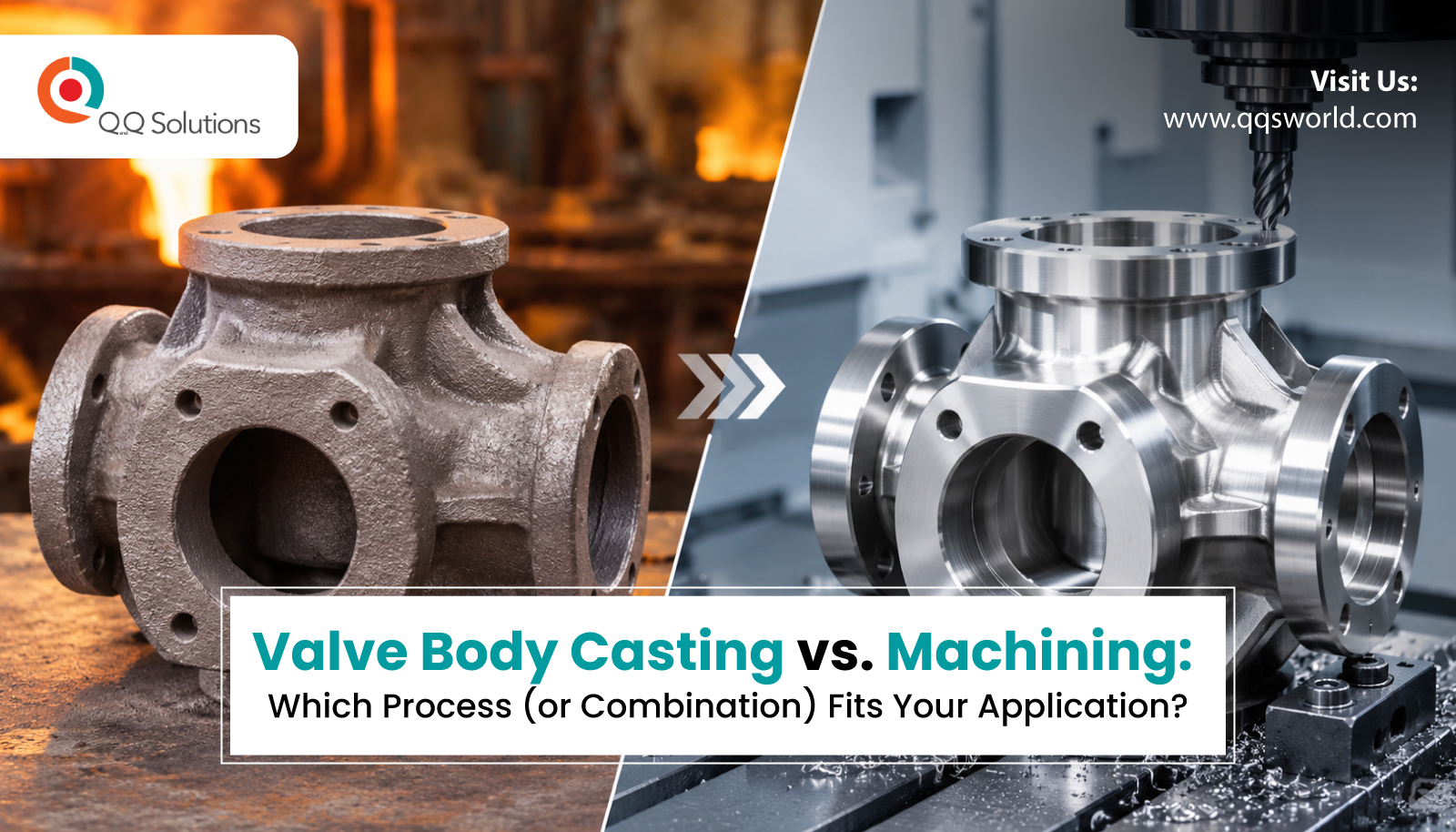
When selecting a manufacturing process for a valve body, the decision is rarely as simple as choosing between casting and machining. Valve bodies are pressure-containing components that must balance material performance, dimensional accuracy, surface finish, manufacturability, cost, and long-term reliability.
For some applications, casting provides the most practical way to produce the required geometry. For others, a fully machined component may be appropriate. In many industrial applications, however, the most effective solution is a combination of casting followed by precision CNC machining.
The right choice depends on the valve design, material, production volume, pressure requirements, dimensional tolerances, internal geometry and downstream finishing requirements.
For manufacturers and procurement teams sourcing valve body casting and machining, understanding where each process adds value can help reduce manufacturing costs without compromising performance.
The valve body is the primary pressure-containing structure of a valve. It houses the internal flow passage and provides the mounting interfaces for components such as seats, stems, discs, actuators and other internal elements.
Depending on the application, valve bodies may be manufactured from carbon steel, stainless steel, ductile iron, alloy steel, aluminium alloys or other engineered materials.
They are used extensively in industries including:
Because valve bodies are exposed to pressure, temperature, corrosion and mechanical loads, manufacturing quality is critical.
Casting is particularly useful when a valve body has a complex geometry, internal cavities or a shape that would require extensive material removal if manufactured entirely from solid stock.
In a casting process, molten metal is formed into a near-net or near-net-shape component. Subsequent machining is then used to achieve the dimensional accuracy required at critical interfaces.
This approach can significantly reduce the amount of material that needs to be removed during machining.
For complex valve geometries, casting can therefore provide an efficient manufacturing foundation.
Casting offers several important benefits.
A casting can incorporate shapes and internal configurations that may be difficult or expensive to produce from a solid block.
This is particularly relevant for valve bodies containing:
Machining a valve body entirely from a large billet can generate significant material waste.
Casting produces a component much closer to the final geometry, reducing machining allowance and material removal.
Once tooling and the casting process have been established, casting can become highly economical for repeat production.
Investment casting and other casting processes can accommodate a broad range of engineering alloys. QQS, for example, works with carbon steel, low-alloy steel, stainless steel and non-ferrous materials including aluminium, brass and bronze for investment cast components.
One of the most important points for buyers is that casting does not automatically produce the final precision required by a valve body.
Cast components can have dimensional variation, surface irregularities and machining allowances.
Critical areas such as:
may require secondary machining.
This is where the combination of casting and CNC machining becomes particularly valuable.
CNC machining removes material from a cast or solid workpiece using computer-controlled cutting tools.
For valve bodies, machining may be used to create highly accurate:
The advantage is repeatable dimensional control on features where accuracy directly affects assembly and performance.
QQS combines casting with CNC machining and secondary operations to manufacture precision components according to customer requirements. Its machining infrastructure includes CNC milling, horizontal machining centres and vertical turning capabilities.
Machining directly from billet or bar stock can be attractive when:
For example, manufacturing ten prototype valve bodies may not justify the tooling investment associated with a casting process.
In such cases, CNC machining can provide a faster route to functional components.
However, as production volume increases, the economics can change significantly.
For many industrial valve applications, the best answer is neither casting nor machining alone.
It is:
Cast the geometry. Machine the critical features. Inspect the finished component.
This approach provides the design flexibility of casting with the dimensional accuracy of CNC machining.
A typical manufacturing route may look like:
Material selection → Pattern/tooling → Casting → Heat treatment → Shot blasting/cleaning → Rough machining → Finish machining → Inspection → NDT/testing → Surface treatment → Final assembly
The exact sequence depends on material and application.
Investment casting can be particularly attractive for smaller and more intricate components.
It is capable of producing complex shapes and reducing the amount of secondary machining required.
For larger valve bodies, other casting methods may be more appropriate depending on size, weight, production volume and geometry.
The manufacturing process should therefore be selected based on the component rather than assuming one casting method is universally superior.
A common mistake in component design is specifying extremely tight tolerances across the entire valve body.
This can increase manufacturing costs without improving functional performance.
Instead, tolerances should be divided according to function.
For example:
Casting stage:
Machining stage:
The objective is not to make every surface equally precise.
The objective is to make every functionally important surface precise enough for its application.
Valve body material should be selected according to the service environment.
Carbon steel may be suitable for certain general industrial applications.
Stainless steel can be advantageous where corrosion resistance is important.
Alloy steels may be appropriate where higher strength or elevated-temperature performance is required.
Ductile iron can be attractive for certain pressure and utility applications where its mechanical characteristics and cost profile align with the design.
Material selection should consider:
Internal porosity can compromise pressure-containing components and may become particularly problematic when machining exposes subsurface defects.
Improper solidification can create shrinkage-related defects.
Heat treatment and casting processes can cause dimensional changes that need to be considered before final machining.
Too much allowance increases machining time, tool wear and material waste.
If machining datums are not correctly established, critical features can become misaligned.
A dimensionally correct component is not necessarily defect-free.
Depending on the application, NDT methods may be required to identify internal or surface discontinuities.
For critical valve applications, inspection can extend beyond dimensional measurement.
Non-destructive testing may include techniques such as:
The appropriate method depends on the material, component geometry, specification and customer requirements.
For buyers sourcing NDT tested parts and assemblies, it is important to establish inspection requirements before production begins rather than treating inspection as an afterthought.
| Factor | Casting | CNC Machining | Casting + Machining |
| Complex geometry | Excellent | Moderate | Excellent |
| Tight tolerances | Limited | Excellent | Excellent |
| Material utilisation | Good | Lower | Very good |
| Initial tooling | Higher | Lower | Moderate |
| Large production volumes | Excellent | Can be expensive | Excellent |
| Prototypes | Less attractive | Excellent | Good |
| Surface finish | Process dependent | Excellent | Excellent |
| Internal passages | Excellent | Can be difficult | Excellent |
| Customisation | Good | Excellent | Excellent |
There is no universal answer.
1. Choose CNC machining when the component is relatively simple, production volume is low, tooling economics are unfavourable or tight tolerances dominate the design.
2. Choose casting when the component has complex geometry, significant material volume or internal features that would make machining inefficient.
3. Choose casting followed by CNC machining when you need complex near-net geometry combined with precise functional interfaces.
For many industrial valve bodies, this third option offers the best balance.
The process itself is only one part of the equation.
A reliable supplier should understand the complete route from drawing to finished component.
That means being able to evaluate:
A supplier capable of coordinating multiple processes can also reduce communication gaps between a foundry and a separate machining vendor.
QQS Solutions provides a combination of casting, CNC machining and other manufacturing capabilities, allowing customers to develop components through a coordinated supply chain rather than treating every process as a separate procurement activity. QQS has been shipping butterfly valves duly assembled and tested. Closer to hundred thousand are already in the field operation without a single incident of product complaint for any premature failure.
The question is not simply whether valve body casting is better than machining.
The more useful question is:
Casting is often best for creating the overall geometry efficiently. CNC machining is best suited to producing critical interfaces with precision. When the two are engineered together, manufacturers can achieve complex shapes, accurate functional features and a commercially practical production process.
For companies sourcing precision machined casting parts, valve body casting and machining, or fully finished metal parts, selecting a manufacturing partner with integrated capabilities can make the difference between simply buying a component and building a reliable long-term supply chain.
