

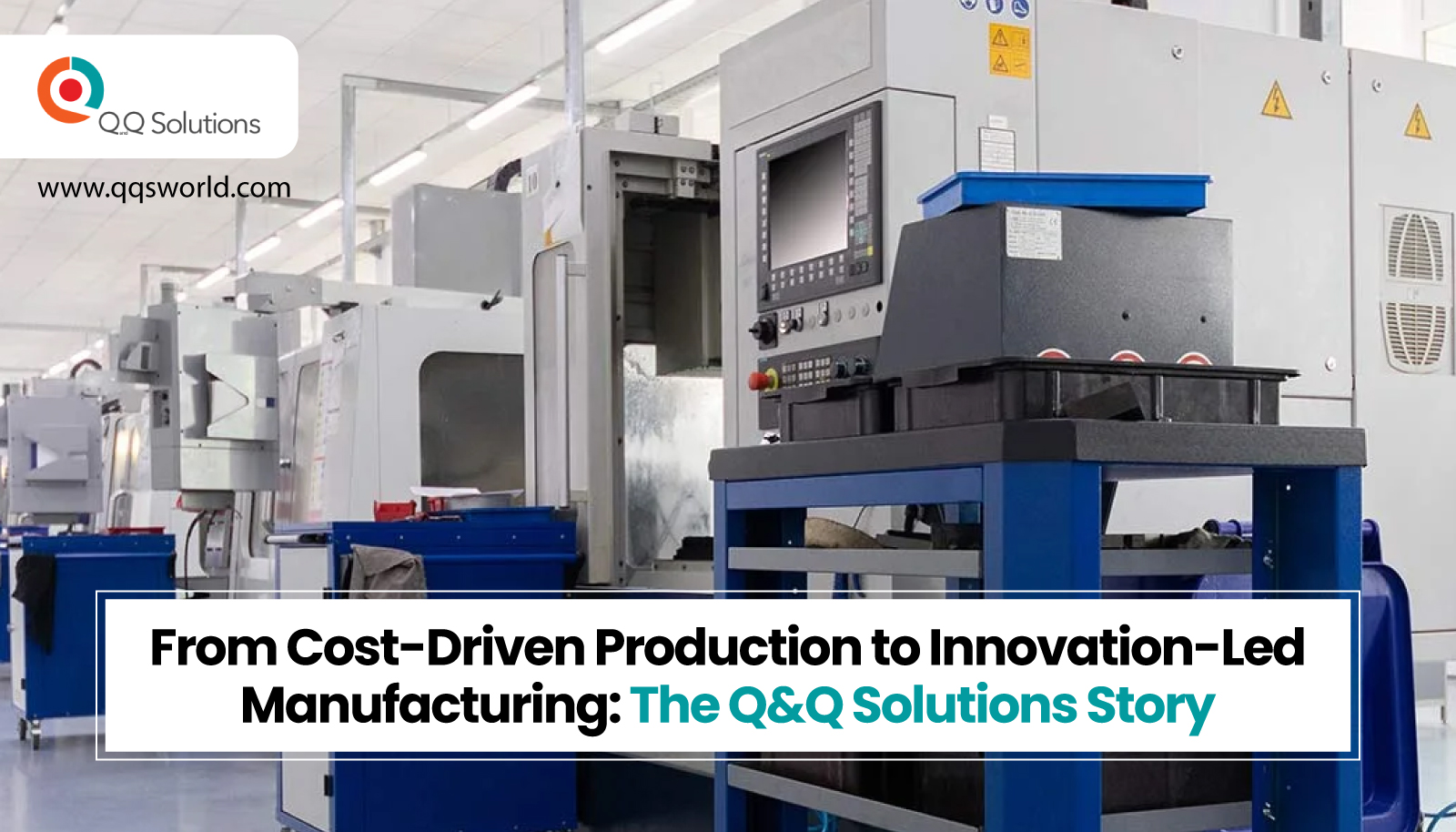
From Cost-Driven Production to Innovation-Led Manufacturing: The Q&Q Solutions Story
July 7, 2026
There is a version of Indian manufacturing that the world has known for decades. It is a version built on a single, well-worn proposition: we can make it cheaper. Lower labour costs, lower overheads, lower price — and for a long time, that proposition was enough. Global OEMs sourced from India because it saved money. Indian manufacturers competed with each other on margins. The conversation, almost without exception, started and ended with cost.
Q&Q Solutions looked at that version of Indian manufacturing and made a deliberate, considered, and — at the time — somewhat contrarian decision.
They decided to change the conversation entirely.
Not from cost to slightly-better-cost. Not from cost to cost-plus-quality. But from cost to competency. From production to innovation. From being a supplier that customers chose because it was economical to being a partner that customers chose because no one else could do what Q&Q does — with the consistency, the depth, and the engineering intelligence that global billion-dollar OEMs demand.
This is the story of that transformation. And it is, by any measure, one of the most significant manufacturing evolution stories to emerge from India in the past decade.
The Starting Point: Understanding What Was Wrong with the Old Model
To understand where Q&Q Solutions has arrived, it helps to understand where the industry it operates in was starting from — and why the cost-arbitrage model, despite its apparent logic, was always a fundamentally fragile foundation on which to build a serious manufacturing business.
The cost arbitrage model works like this: a manufacturer in a low-cost economy produces components that are functionally equivalent to what a manufacturer in a high-cost economy produces, but at a lower price because labour and operational costs are lower. The buyer saves money. The supplier wins business. Everyone appears to benefit.
But the model has four deep structural weaknesses that compound over time.
First, it is permanently temporary.The moment another geography — Vietnam, Bangladesh, Mexico, Eastern Europe — offers lower costs than you do, your competitive advantage evaporates. You have built your entire business case on a variable that is outside your control and will inevitably change. Cost arbitrage is not a moat. It is a sandcastle.
Second, it attracts the wrong kind of customer relationships. When a customer chooses you primarily because you are cheap, price is always the central variable in every conversation. Any price increase — however justified by input cost inflation, currency movements, or investment in quality — is a negotiation crisis. Loyalty is superficial. The relationship is transactional, not strategic.
Third, it suppresses investment in capability. A manufacturer competing primarily on price operates on thin margins. Thin margins leave little room for investment in technology, people, processes, and innovation. The very nature of the cost-arbitrage model makes it self-limiting — it prevents manufacturers from building the capabilities that would allow them to escape the model.
Fourth, and most critically, it misrepresents what Indian engineering is actually capable of. India produces extraordinary engineers, metallurgists, manufacturing scientists, and technical innovators. Constraining that talent pool to cost-optimised production of standard components is not just a business strategic error — it is a fundamental misallocation of capability.
Q&Q Solutions understood all of this. And they built their business model in deliberate, systematic opposition to it.
Shifting the Conversation: From Cost to Competency
The phrase “We shifted the conversation from cost to competency” is more than a marketing line for Q&Q Solutions. It is an operational philosophy that has shaped every significant business decision the company has made — from what customers to pursue, to what capabilities to build, to what technology to invest in, to what kinds of problems to position the organisation to solve.
Shifting from cost to competency means several specific, concrete things in practice.
It means pursuing complexity rather than avoiding it. Cost-optimised manufacturers gravitate toward high-volume, low-complexity parts where process standardisation delivers the margin efficiency their model requires. Q&Q Solutions deliberately moved in the opposite direction — toward complex assemblies, multi-component systems, technically demanding parts that require engineering intelligence to produce, not just process efficiency. Today, QQS is focused on complex assemblies that can weigh up to 3 tonnes — the kind of work that requires deep metallurgical knowledge, precise process control, advanced fixturing, and an engineering team that can translate a demanding customer drawing into a consistently deliverable manufactured reality.
It means building depth of relationship, not breadth of transaction. One of the most telling statistics in Q&Q Solutions’ story is this: over 250 parts developed for the same customer. Think about what that number means. It means that a single customer trusted Q&Q with 250 distinct development challenges. It means that every time that customer had a new complex component problem, they came back to QQS. It means that the relationship had evolved far beyond a supplier-buyer transaction into a genuine technical partnership — where QQS’s engineering capability was embedded in the customer’s own product development and manufacturing process. This is the opposite of the cost-arbitrage model,
where a customer might place a price-competitive order and then equally easily move it to a cheaper alternative. You do not replicate 250 parts of development history overnight. That depth of relationship is genuinely irreplaceable.
It means investing in technology as a competitive weapon, not just a productivity tool. The most visible expression of this investment is Q&Q Solutions’ in-house developed Manufacturing Execution System — their proprietary digital backbone. In an industry where most manufacturers use generic ERP software or, in smaller operations, paper-based systems, QQS built their own MES. This is a remarkable decision that reflects a genuine understanding of where manufacturing competitive advantage lies in the Industry 4.0 era. A purpose-built MES is not just an operational efficiency tool — it is a data asset, a quality management platform, a customer visibility portal, and a continual improvement engine. It gives QQS visibility into every stage of production, every parameter variation, every quality signal — in real time. It allows them to promise their customers not just quality, but documented, traceable, reproducible quality. And it creates a capability gap between QQS and their competitors that is genuinely difficult to close.
Industry 4.0 as a Strategic Choice, Not a Buzzword
The manufacturing world has been saturated with Industry 4.0 rhetoric for years. For many companies, it has been more vocabulary than reality — a set of aspirational terms attached to essentially unchanged operations to make marketing materials sound contemporary.
Q&Q Solutions’ relationship with Industry 4.0 is entirely different. It is operational, specific, and deeply integrated into the way the company actually functions.
Industry 4.0, at its core, is about the integration of digital intelligence into physical manufacturing processes — using data, connectivity, automation, and advanced analytics to make manufacturing more precise, more predictable, more efficient, and more responsive. When implemented genuinely, it transforms manufacturing from an art practised by experienced craftspeople into a science managed by systems — without losing the engineering intelligence that experienced people provide, but making that intelligence systematic, scalable, and reproducible.
For Q&Q Solutions, the Industry 4.0 journey has centred on three interconnected capabilities.
Digital process integration — through the in-house MES, every production process at QQS is digitally tracked and controlled. Process parameters, quality measurements, material traceability, machine performance, and production scheduling are all managed through a single integrated system. This eliminates the information silos that plague most manufacturing operations and gives management real-time visibility into the entire production system.
Data-driven quality management — rather than relying on end-of-line inspection to catch quality problems after they have already occurred, QQS uses process data to predict and prevent quality deviations before they reach the inspection stage. This is not just more efficient than reactive quality control — it is fundamentally more reliable, because it addresses root causes rather than symptoms.
Continual improvement infrastructure — Industry 4.0 manufacturing generates enormous amounts of process data. The companies that extract maximum value from this data are those with the analytical infrastructure and organisational culture to turn data into insight and insight into action. QQS has built both — the systems to capture and analyse production data, and the culture to act on what that data reveals.
The result is a manufacturing operation that grows smarter with every batch it produces — accumulating process knowledge, refining parameters, tightening tolerances, and continuously closing the gap between what the drawing specifies and what the production process delivers. This is the compounding advantage of a data-driven manufacturing model: the longer you operate it, the better it gets. And the harder it becomes for competitors without the same data infrastructure to catch up.
40% CAGR: What Sustained Growth Reveals About a Business Model
Q&Q Solutions has sustained a 40% compound annual growth rate — a number that deserves examination not just as a metric of business success, but as evidence of the validity of the model underlying it.
40% CAGR is not a number that cost arbitrage produces. Cost-optimised manufacturers in competitive commodity segments typically grow at single-digit rates in line with industry growth, with occasional step changes when they win large volume contracts that are equally vulnerable to being lost to lower-cost competitors. Sustained 40% growth in precision manufacturing requires something different — it requires a business that is genuinely creating value that customers cannot easily source elsewhere.
The sources of Q&Q Solutions’ growth story reflect exactly this dynamic.
Deepening existing customer relationships — as the 250+ parts statistic demonstrates, QQS grows with its customers. Each successful component developed creates confidence and opens the door to the next challenge. The relationship deepens over time rather than remaining static. A customer who started with a single component order is today bringing their most complex assembly challenges to QQS — because the track record is there, the capability is demonstrated, and the relationship is trusted.
Expanding the geographic footprint — 10 countries and counting. Q&Q Solutions exports precision-engineered components and assemblies globally, serving OEMs across markets that have historically sourced from established manufacturing hubs in Europe, North America, and East Asia. The fact that global OEMs with access to manufacturing options worldwide are choosing QQS — and continuing to choose QQS — is the most powerful validation of the competency-led model. These are sophisticated buyers with rigorous supplier qualification processes. They are not choosing QQS because it is cheap. They are choosing QQS because it is good.
Moving up the value chain — from components to assemblies to fully assembled and tested solutions. This progression represents the most significant expression of Q&Q Solutions‘ strategic evolution. A company that produces individual components is a parts supplier. A company that produces assembled, tested, globally delivered solutions is a systems partner. The revenue per unit, the margin, the switching costs, and the strategic
importance to the customer are all fundamentally different at the assembly level versus the component level. QQS has systematically moved up this value chain — building the assembly capability, the testing infrastructure, and the logistics competency to deliver not just parts but performance.
26 Products in 52 Weeks: The Innovation Clock
One of the most striking data points in Q&Q Solutions’ story is the development of 26 products in 52 weeks for billion-dollar companies. Averaged out, that is a new product every two weeks — sustained across an entire year, for customers with the most demanding engineering and quality standards in the world.
This is not production. This is innovation at an industrial pace.
Product development in precision metal components manufacturing is genuinely difficult. It requires translating a customer’s drawing — which may have ambiguities, tolerance challenges, or material requirements that push the boundaries of standard process capability
— into a repeatable, quality-controlled production process. It requires tooling design and fabrication, process parameter optimisation, first article inspection, dimensional verification, and customer approval before a single production unit ships. It requires the ability to manage multiple development projects simultaneously without allowing any of them to compromise the quality or delivery of ongoing production.
The ability to execute 26 product developments in 52 weeks — for billion-dollar companies who have zero tolerance for inadequate quality or missed timelines — tells you something fundamental about Q&Q Solutions. It tells you that the organisation has:
A development process that is systematic and repeatable, not dependent on individual heroics. Engineering capability deep enough to solve new problems quickly and confidently. Quality systems robust enough to compress the qualification cycle without compromising the rigour of the output. Project management maturity sufficient to run multiple parallel development tracks without losing control of any of them. And a culture of urgency and accountability that treats customer timelines as non-negotiable commitments rather than aspirational targets.
This development velocity is itself a competitive advantage. In markets where customers need new components developed quickly, a supplier that can reliably deliver qualified parts within tight timeframes is not replaceable by a cheaper competitor who takes twice as long.
The Sectors Where This Matters Most
Q&Q Solutions’ capabilities are deployed across industries where the consequences of manufacturing failure are not inconvenient — they are catastrophic. This is not accidental. It reflects a deliberate choice to operate in sectors where engineering depth and quality reliability command genuine value, rather than in commodity markets where price competition is structural and unavoidable.
Oil and Gas — the most demanding application environment in precision manufacturing. Components for oil and gas applications operate under extreme pressure, extreme
temperature, and in the presence of corrosive media that would destroy less rigorously engineered parts within weeks. The qualification standards — material traceability, dimensional verification, NDT requirements, and pressure testing — are among the most rigorous in any industry. Winning and sustaining oil and gas business requires a manufacturing organisation that genuinely operates at this standard, not one that aspirationally claims to.
Offshore and Marine — similar severity of operating environment, with the added complexity of saltwater corrosion, wave-induced dynamic loading, and the operational reality that failures in offshore environments are extraordinarily expensive and dangerous to remediate. Customers in this sector do not switch suppliers for marginal cost savings. They work with suppliers they absolutely trust.
Renewable Energy — Wind — one of the fastest-growing sectors in global manufacturing, and one that requires components with very specific combinations of properties: fatigue resistance over very long service lives, high dynamic load capacity, corrosion resistance, and dimensional precision that allows field assembly without adjustment. As the global wind energy buildout accelerates, demand for precision-manufactured components from suppliers with the capability and capacity to deliver at scale is growing rapidly.
Heavy Engineering — the bedrock of industrial infrastructure worldwide. Complex assemblies for heavy engineering applications represent Q&Q Solutions’ core competency in its most concentrated form — large, complex, multi-component, high-consequence assemblies where getting it right requires every dimension of manufacturing excellence operating simultaneously.
Where Metal Meets Mettle: The Philosophy Behind the Brand
The tagline “Where Metal Meets Mettle” deserves attention as more than a brand phrase. It is a precise articulation of what Q&Q Solutions actually believes about manufacturing excellence.
Metal — the material. The physical substance from which every component, every assembly, every shipped unit is made. Metal is obedient to physics and chemistry. It responds to process parameters, heat treatment, surface treatment, and machining according to laws that do not negotiate. Working with metal at the precision levels Q&Q Solutions operates requires a deep, respectful, continuously updated understanding of material science.
Mettle — the human quality. Courage, determination, resilience, and the willingness to take on difficult challenges rather than retreat to the safety of simpler problems. Mettle is what drives an engineering team to solve a development problem in two weeks that another organisation would take two months to address. It is what drives a management team to invest in a proprietary MES rather than accepting the limitations of generic software. It is what drives an organisation to compete on competency in a market that defaults to cost.
The intersection of these two — metal and mettle — is precisely where Q&Q Solutions operates. And it is an intersection that produces something that neither element achieves alone: manufacturing excellence at the highest level the market demands, delivered with the
consistency, the urgency, and the engineering intelligence of a team that has chosen this level of challenge deliberately.
The ₹500 Crore Equity Funding Journey: What It Signals
Q&Q Solutions is on course to ₹500 Crore in equity funding — a milestone that, in the context of precision manufacturing in India, is genuinely significant.
Equity funding in manufacturing is not granted to companies competing on price. Investors who write large equity cheques for manufacturing businesses are looking for businesses with defensible competitive advantages — proprietary technology, deep customer relationships, capabilities that are difficult to replicate, and growth models that are structural rather than cyclical. They are looking for manufacturing businesses that behave more like technology businesses in their capacity to generate sustainable returns.
The fact that Q&Q Solutions is on course to this milestone is the investment community’s validation of everything discussed above. It is external confirmation that the competency-led, innovation-driven, Industry 4.0-integrated model is not just operationally impressive but structurally sound as a business.
The funding, when secured, will not be used to become cheaper. It will be used to become better — deeper engineering capability, broader technology infrastructure, expanded geographic reach, and enhanced capacity to take on the most complex and demanding manufacturing challenges that global OEMs need solved.
What Innovation-Led Manufacturing Looks Like in Practice
It is worth being concrete about what the shift from cost-driven production to innovation-led manufacturing actually looks like at the operational level — because innovation in manufacturing is sometimes romanticised in ways that obscure what it actually means.
In the Q&Q Solutions context, innovation-led manufacturing means:
Engineering problems solved before production begins. When a customer drawing arrives, the first activity is not process planning for the cheapest route to a conforming part. It is engineering analysis — DFM review, process risk assessment, material verification, tolerance analysis — to understand the challenges the component presents and design the optimal manufacturing approach before any metal is cut.
Process knowledge accumulated systematically. Every batch produces process data. Every quality measurement adds to the understanding of how the production system behaves. Over time, this accumulated knowledge becomes a competitive asset — a deep, organisation-level understanding of how to produce specific component types in specific materials to specific quality levels that no new entrant can replicate without years of production history.
Customer problems solved proactively. Innovation-led manufacturers do not wait for customers to identify problems. They develop enough understanding of their customers’ products and processes to identify challenges the customer may not yet have encountered
— and to come to the customer with solutions. This proactive contribution is what transforms a supplier relationship into a development partnership.
Quality owned, not inspected. In cost-driven production, quality is a gate at the end of the process — a check that separates conforming from non-conforming parts. In innovation-led manufacturing, quality is built into every step of the process. It is a result of process design, parameter control, tooling precision, and material management — not an inspection activity.
Delivery treated as an engineering discipline. On-time delivery in complex manufacturing is not a logistics function — it is a manufacturing planning and execution discipline.
Sustaining delivery performance on complex assemblies across global supply chains requires the same kind of systematic, data-driven management as quality. QQS’s MES is as much a delivery management system as it is a quality system.
The Broader Significance: What Q&Q Solutions Means for Indian Manufacturing
Q&Q Solutions is not just a business success story. It is a proof point for a different vision of what Indian manufacturing can be — and increasingly is becoming.
For decades, the narrative around Indian manufacturing in global supply chains has been dominated by the cost argument. India has been positioned as a source of economical production for global OEMs — valuable, but valuable primarily because it is affordable. This narrative, while historically accurate in some respects, has consistently undersold the genuine engineering capability, metallurgical expertise, and manufacturing sophistication that exists within the Indian industrial ecosystem.
Companies like Q&Q Solutions are changing this narrative through the most persuasive means available: demonstrated performance. When a company based in India exports 3 million precision-engineered parts to 10 countries — including technologically sophisticated markets in Europe and North America — and does so not because it is the cheapest option but because it is the most competent option, it changes the conversation about Indian manufacturing at a fundamental level.
It demonstrates that India can compete on engineering intelligence, not just labour cost. It demonstrates that Indian manufacturers can build the technology, quality, and management systems that the most demanding global customers require. It demonstrates that the shift from cost-driven production to innovation-led manufacturing is not a theoretical ambition but a practically achievable reality.
And it establishes a new benchmark — a new expectation — for what Indian precision manufacturing companies can and should aspire to be.
Conclusion: The Conversation Has Changed
Q&Q Solutions set out to change the conversation in Indian manufacturing — from cost to competency, from production to innovation, from being chosen because it was affordable to being chosen because it was indispensable.
The evidence that this conversation has changed is everywhere in the company’s story.
It is in the 250+ parts developed for the same customer — a relationship so deep that cost was never the primary variable in its continuation. It is in the 26 products developed in 52 weeks for billion-dollar companies — a development velocity that only genuine engineering capability makes possible. It is in the 40% year-on-year growth — a trajectory that cost arbitrage cannot sustain but competency can. It is in the 10 countries served — markets where sophisticated buyers with global options chose a manufacturer from Coimbatore because they couldn’t find better elsewhere. It is in the in-house MES — a technology investment made not because it was the easiest or cheapest path, but because it was the right one for building a manufacturing operation worthy of global OEM trust.
And it is in the tagline that says everything about who Q&Q Solutions is and what they have chosen to stand for:
Where Metal Meets Mettle.
The conversation has changed. And Q&Q Solutions changed it.
To explore partnership opportunities, discuss complex assembly requirements, or learn more about Q&Q Solutions‘ global manufacturing capabilities, contact the team at +91 63649 27371 or +91 97894 73165.