



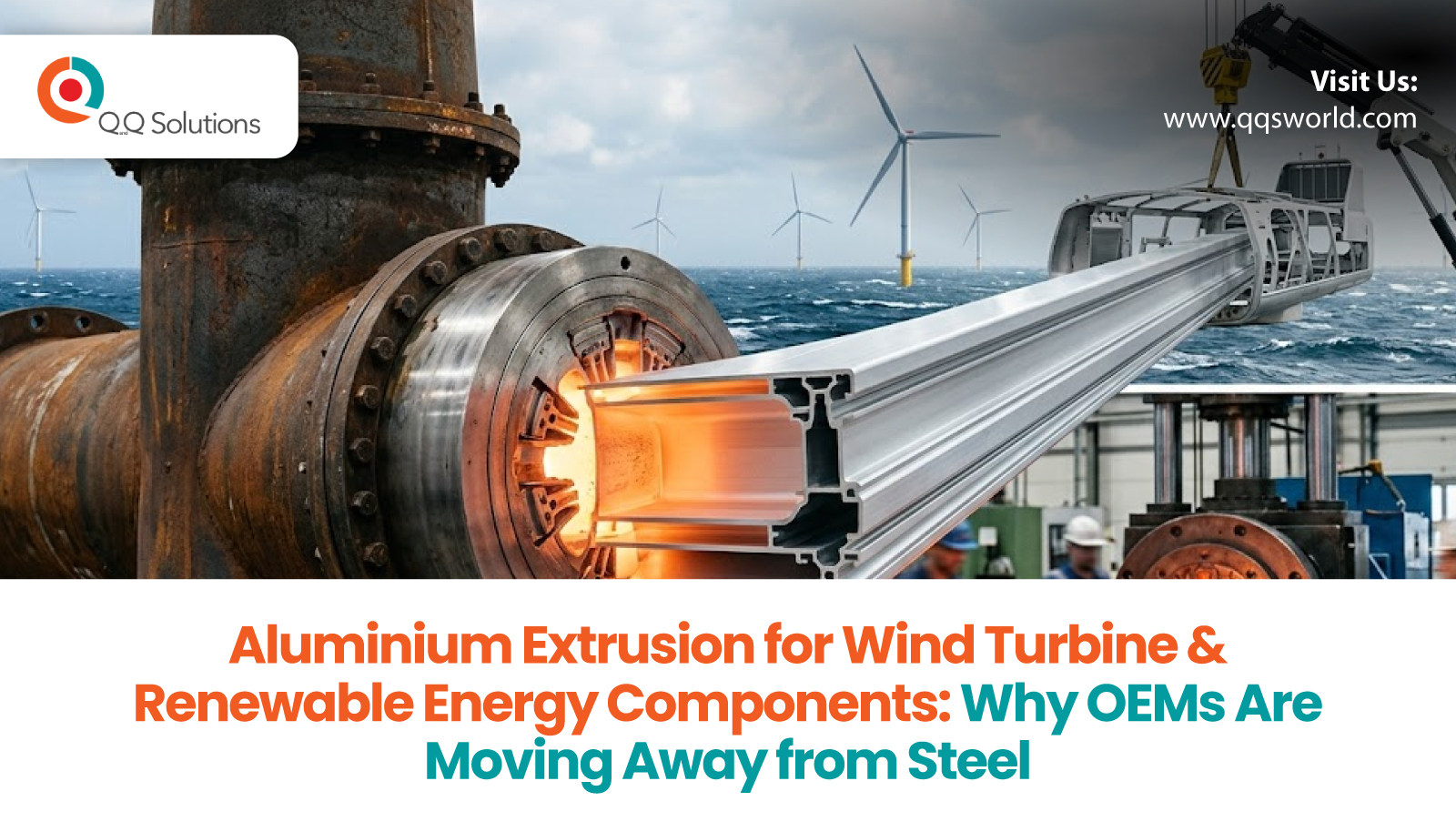
Aluminium Extrusion for Wind Turbine & Renewable Energy Components: Why OEMs Are Moving Away from Steel
August 25, 2026
Steel has been the default material for structural and housing components in wind energy for decades, and for good reason — it’s strong, well-understood, and widely available. But over the past several years, a growing number of wind turbine and broader renewable energy OEMs have been shifting specific components from steel fabrication to aluminium extrusion, particularly for nacelle housings, cable management systems, cooling assemblies, control cabinet frames, and structural brackets that don’t carry the primary tower or blade loads.
This isn’t a fashion trend — it’s a materials and manufacturing decision driven by weight, corrosion performance, and the way extrusion changes the economics of complex cross-sections at scale. Here’s what’s actually behind the shift, and where it makes sense.
The Core Drivers: Why Aluminium, Why Now
- Weight reduction with real downstream impact: Aluminium’s strength-to-weight ratio is roughly three times better than mild steel for equivalent structural stiffness in many cross-section designs. In a wind turbine, weight isn’t just a material cost issue — it cascades through the whole system. Every kilogram saved in a nacelle-mounted component reduces the load the tower and foundation need to support, and reduces the inertial loads during yaw and pitch operation. For components mounted high in the nacelle or rotating with the hub, weight savings have outsized value compared to the same saving on a ground-level structure.
- Corrosion resistance without a coating dependency: Wind installations — onshore in coastal regions and virtually all offshore projects — operate in some of the most corrosive environments in industrial equipment. Steel components rely entirely on coatings (galvanizing, painting, powder coating) for corrosion protection, and coating failure at height or offshore is expensive and difficult to remediate. Aluminium forms a stable, self-passivating oxide layer that provides inherent corrosion resistance, particularly relevant for enclosures, cable trays, and housings exposed to salt-laden air or condensation cycles.
- Extrusion enables complex cross-sections that steel fabrication can’t match economically: This is the manufacturing angle that often gets underweighted in the materials conversation. Aluminium extrusion pushes heated billet through a shaped die, producing a continuous profile with a cross-section as complex as the die allows — integrated mounting channels, cable raceways, cooling fins, and structural ribs all formed in a single pass. Replicating that geometry in steel would require multiple fabrication steps: cutting, welding, and machining separate pieces together, each adding cost, weld-related distortion risk, and inspection burden.
- Consistency at volume: Wind OEMs building components across large turbine fleets need dimensional consistency across thousands of linear meters of profile. Extrusion delivers that consistency inherently — once a die is qualified, every meter of extruded profile carries the same cross-section, versus welded steel fabrications where each weld introduces potential variation and residual stress.
- Thermal conductivity for cooling applications: Aluminium’s thermal conductivity (roughly four times that of steel) makes it the natural choice for heat-sink structures and cooling housings around power electronics, converters, and generator cooling systems — a growing share of the componentry in modern turbines as power ratings increase.
Where Steel Still Wins
This shift doesn’t mean aluminium is replacing steel across the board, and a responsible engineering assessment has to be honest about where steel remains the better choice:
- Primary structural load paths — tower sections, main shafts, gearbox housings, and foundation components still rely on steel’s higher absolute strength and stiffness, and the engineering codes and fatigue data supporting these designs are steel-based.
- High cyclic fatigue applications — steel’s fatigue behavior is generally better characterized and more forgiving at the very high cycle counts turbine components accumulate over a 20+ year design life, particularly for welded steel assemblies designed against well-established fatigue curves.
- Cost per unit strength at very large cross-sections — for very large structural members, steel’s lower raw material cost per unit of load-bearing capacity can outweigh aluminium’s weight advantage.
The realistic pattern OEMs are converging on is hybrid material selection: steel retained for primary structural and high-fatigue load paths, aluminium extrusion adopted for housings, enclosures, brackets, cable management, and secondary structural components where weight and corrosion resistance matter more than absolute peak strength.
Machining Considerations for Extruded Aluminium Components
Extrusion produces the profile — but wind turbine components almost always need secondary CNC machining to reach final spec: mounting hole patterns, mating faces, cut lengths, and mitered joints for frame assemblies. A few things matter here that are specific to aluminium:
- Faster material removal rates than steel, but with a real risk of built-up edge and poor surface finish if cutting parameters aren’t tuned for aluminium’s gummier chip formation — this needs machining programs specifically optimized for the alloy, not steel parameters scaled down.
- Tighter control of clamping force during fixturing, since aluminium extrusions are more prone to distortion under clamping pressure than equivalent steel sections, particularly on thin-walled profiles.
- Alloy selection matters for the machining outcome, not just the mechanical spec — 6000-series alloys (6061, 6063) are the common choice for structural extrusions and machine well; 6063 in particular is favored where surface finish and extrudability of complex profiles both matter.
- Post-machining surface treatment — anodizing is common for both corrosion protection and cosmetic consistency on visible components, and needs to be planned into the process sequence since it affects final dimensional tolerance slightly.
What This Means for Sourcing Decisions
For renewable energy OEMs evaluating this shift, the practical question isn’t “aluminium or steel” as a blanket policy — it’s component-by-component: does this part carry primary structural load, or is it a housing, bracket, enclosure, or cable-management structure where weight and corrosion resistance are the dominant design drivers? Getting that assessment right, component by component, is what actually captures the weight and cost benefits without introducing risk into load-bearing structure.
It also means the manufacturing partner matters as much as the material choice. Extrusion die design, alloy selection, and downstream CNC machining need to be handled by a team that understands both the metallurgy and the machining behavior of aluminium — not treated as a drop-in replacement for a steel fabrication drawing.
QQS works with industrial and renewable energy manufacturers on precision-machined aluminium and steel components alike, from casting and extruded stock through to fully finished, tested assemblies. If you’re evaluating a steel-to-aluminium transition for a specific component in your turbine or renewable energy platform, we can help assess where the switch makes engineering and cost sense — and where it doesn’t.
Reach out to QQS to discuss your aluminium or steel component requirements for renewable energy applications.