



Open Die vs Closed Die Forging: Which Process Is Right for Heavy Engineering & Off-Road Truck Parts?
August 25, 2026
For engineers specifying axle components, suspension parts, drive-train elements, or structural members for heavy engineering and off-road equipment, one of the earliest and most consequential decisions is the forming process itself: open die forging or closed die forging. Both produce the grain-refined, high-strength forgings this kind of equipment demands — but they arrive there through very different processes, with different implications for tolerance, tooling investment, batch size, and final cost.
Choosing wrong doesn’t just mean paying more than necessary. It can mean committing to tooling that doesn’t make sense for your volumes, or accepting a part geometry that adds unnecessary machining downstream. Here’s how to think through the decision.
What Actually Happens in Each Process
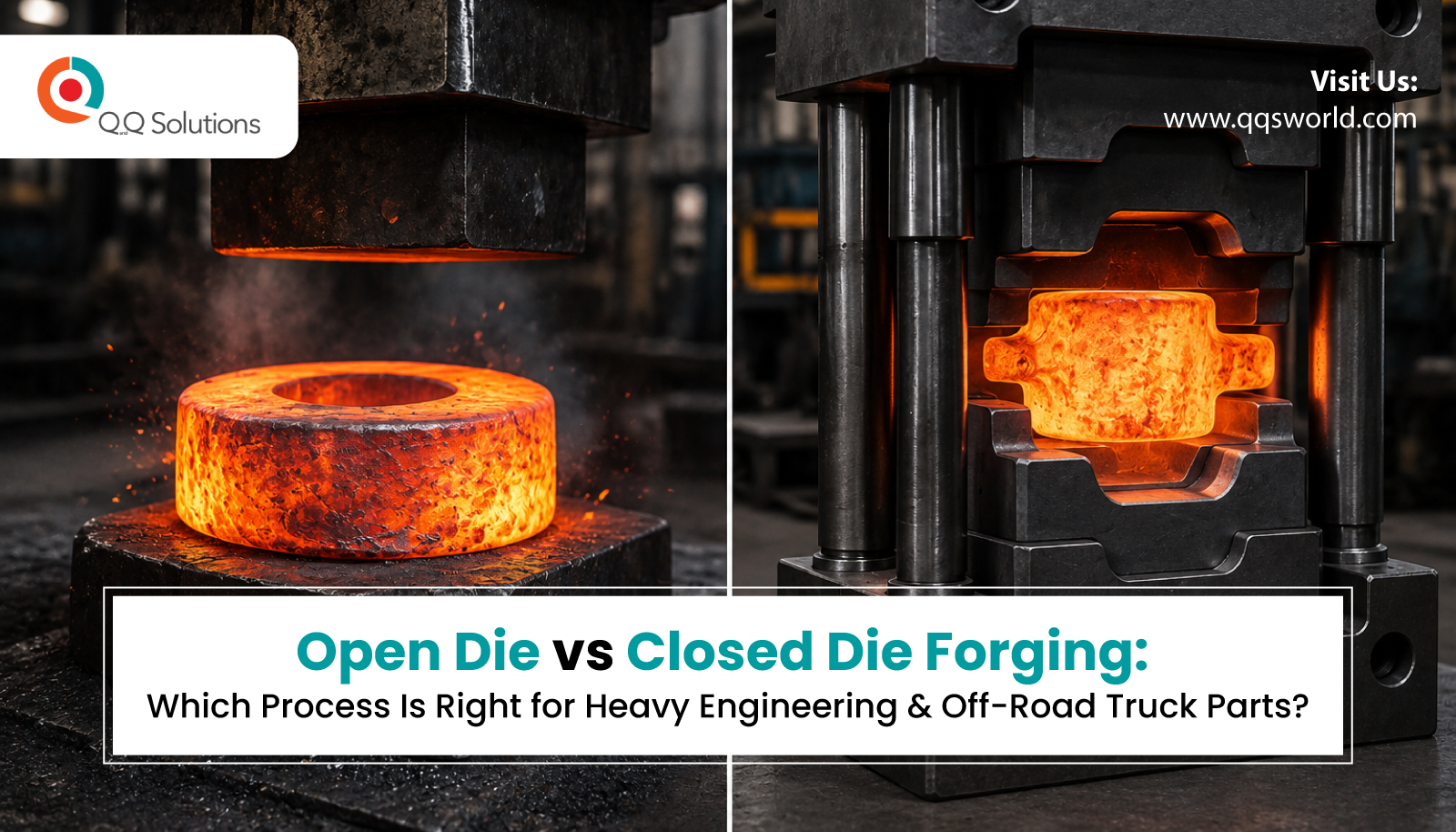
Open die forging shapes metal between flat or simply contoured dies that never fully enclose the workpiece. The operator (or CNC-controlled manipulator on modern equipment) repeatedly repositions and deforms the stock through a series of strikes, progressively working it toward the target shape. There’s no die cavity constraining the final form — the geometry comes from controlled, repeated deformation.
Closed die forging (also called impression die forging) uses two die halves machined with a cavity matching the part’s near-final shape. The heated billet is placed between the dies and struck under high pressure, forcing the metal to fill the cavity. Excess material is squeezed out as flash and trimmed afterward.
The practical consequence: open die forging produces simpler geometric forms — shafts, discs, blocks, rings, step-shafts — with generous machining allowance, while closed die forging produces complex, near-net shapes that closely match the final part geometry.
Comparing the Two Processes
Tooling investment and lead time Open die forging uses generic flat or v-shaped dies that aren’t part-specific, so there’s no tooling lead time or amortization cost. Closed die forging requires a dedicated die set machined to the part geometry — a real upfront investment that only makes sense when it’s spread across enough parts.
Batch size economics This is usually the deciding factor. Open die forging is efficient for one-off parts, prototypes, and low-to-medium volumes because there’s no tooling cost to recover. Closed die forging becomes economical once volumes are high enough (often several hundred to thousands of pieces, depending on part size and complexity) to amortize the die cost against per-part savings in material and machining time.
Material utilization and machining allowance Open die forgings carry more stock allowance because the shape isn’t fully controlled — expect more roughing time and more scrap in downstream CNC machining. Closed die forgings arrive much closer to net shape, with grain flow following the part’s actual contours (a real strength advantage for parts with complex load paths, like steering knuckles or connecting rods), and significantly less machining stock to remove.
Achievable geometry Open die forging is fundamentally limited to axisymmetric or simple prismatic shapes. Closed die forging can produce complex three-dimensional geometry — ribs, bosses, varying cross-sections — in a single forming operation.
Grain flow and mechanical properties Both processes refine grain structure compared to cast or bar stock, improving fatigue strength and toughness. Closed die forging has an edge for complex parts because the die cavity directs grain flow to follow the part’s contours precisely, which matters most on components subject to cyclic or impact loading — exactly the service profile of off-road truck axle and suspension components.
Where Each Process Fits in Heavy Engineering and Off-Road Applications
Open die forging is the right call for:
- Large step-shafts, rollers, and rings used in heavy engineering equipment (crushers, mills, construction machinery)
- Low-volume or one-off replacement parts for legacy equipment
- Prototype or pre-production runs before committing to closed-die tooling
- Simple axisymmetric components like solid or hollow shafts, where the machining allowance from open die forging doesn’t add meaningful cost
Closed die forging is the right call for:
- Steering knuckles, control arms, axle beams, and other suspension/drive-train components with complex geometry and high cyclic loading
- Off-road truck parts produced in medium-to-high volumes, where die cost amortizes quickly
- Components where grain flow directly along load paths is a functional requirement, not just a nice-to-have
- Parts where reducing downstream machining time materially affects unit cost at volume
A practical middle ground worth knowing about: near-net-shape closed die forging combined with precision CNC finish machining is now the standard approach for most structural off-road and heavy equipment components. The forging establishes grain flow and bulk strength; CNC machining brings critical bores, mounting faces, and mating surfaces to final tolerance. Getting this handoff right — where the forging supplier and the machining supplier work from the same understanding of finish-machining allowance — is often what separates a smooth production ramp from a program full of fit-up problems.
Cost Comparison: A Realistic View
It’s tempting to think of open die forging as “the cheaper option” because it avoids tooling cost, but that’s only true below a certain volume threshold. Beyond that threshold, closed die forging is almost always cheaper per part, because:
- Less raw material is wasted as scrap
- Machining time drops significantly with near-net geometry
- Cycle times per part are typically faster once tooling is in place
The crossover point depends heavily on part size, complexity, and material, but as a rough guide: for small-to-medium structural parts with moderate complexity, closed die forging often becomes the lower-cost option somewhere between 200–500 pieces. Below that, open die forging (or forging combined with heavier CNC roughing) usually wins.
Questions to Ask Before Choosing
- What’s the realistic annual volume, including spares and service parts? Tooling amortization only works if the volume is real, not aspirational.
- Does the part geometry require directional grain flow for fatigue performance, or is it simple enough that open die forging plus machining gets you there just as reliably?
- How much finish machining will either route require, and does your supplier have the CNC capacity to handle that downstream work without becoming the bottleneck?
- Is this a legacy or replacement part where closed-die tooling investment doesn’t make sense regardless of theoretical per-part economics?
A Manufacturing Partner Who Handles Both Ends
The forging decision doesn’t happen in isolation from machining — and that’s where a lot of heavy engineering and off-road truck programs run into friction, coordinating between a forge shop and a separate CNC house that don’t share tolerance data or machining allowance assumptions.
QQS operates as a combined casting, forging-adjacent, and CNC precision machining partner for heavy engineering, industrial, and off-road equipment manufacturers. Whether your part is better suited to open die forging with finish machining, or a closed-die near-net-shape approach feeding directly into our CNC lines, we help determine the right process for your actual volumes — not just the theoretically ideal one — and deliver fully machined, tested components ready for assembly.
Talk to QQS about your forged or machined component requirements.